

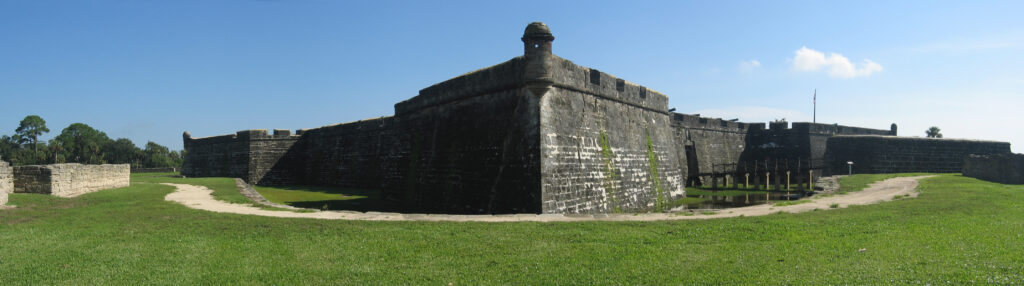
St. Augustine, founded by Spain in 1565, is the oldest continuously inhabited European-founded city in the United States, and three unhurried days are just right to absorb it. A long weekend lets you explore the fort and the old town at walking pace, admire the Gilded Age architecture of Henry Flagler, spend an afternoon by the sea and, from late November to mid-January, see the historic district glowing during Nights of Lights.
Why St. Augustine feels different
Most American cities are counted in decades; St. Augustine is counted in centuries. Pedro Menéndez de Avilés claimed the site for Spain more than four decades before the English settled Jamestown, and the city later passed to Britain, back to Spain and finally to the United States. Each era left its mark in the narrow streets, the coquina walls and the courtyards hidden behind wooden gates.
The result is a city that rewards slowness. Distances in the historic core are short, the scale is human, and the best moments often come from turning into a side street and finding a quiet garden or a centuries-old doorway.
Day one: the fort and the old town
Begin at the Castillo de San Marcos, the masonry fortress Spain began building in 1672 to guard the city and the treasure routes along the coast. Its walls are made of coquina, a stone of compressed shells that absorbed cannon fire rather than shattering. Today it is a national monument managed by the National Park Service, with rangers, cannon-firing demonstrations on many days and wide views over Matanzas Bay from the gun deck. Arrive early to enjoy it before the tour groups; entry fees and hours are set by the park service, so check before visiting.
From the fort, walk through the City Gate onto St. George Street, the pedestrian spine of the old town. It is busy at midday, but the parallel lanes, Aviles Street among them, are calmer and more atmospheric. In the late afternoon, cross the Bridge of Lions on foot for the classic view back toward the skyline of towers and spires.
Day two: Flagler’s Gilded Age
In the 1880s the railroad and oil magnate Henry Flagler set out to make St. Augustine a winter resort for wealthy northerners, and he built on a scale that still astonishes. His Hotel Ponce de Leon, opened in 1888 in a lavish Spanish Renaissance Revival style, is now the heart of Flagler College; guided tours reveal its rotunda, its Tiffany glass and its gilded dining hall.
Across the street, the former Hotel Alcazar houses the Lightner Museum, an eclectic collection of 19th-century decorative arts set around what was once the hotel’s grand indoor pool. Nearby, the Moorish-style Casa Monica, another Gilded Age hotel later acquired by Flagler, still welcomes guests. Together the three buildings form one of the finest ensembles of resort architecture in the country.
Spend the afternoon on Anastasia Island: climb the St. Augustine Lighthouse for a view over the inlet, then walk the broad beach at Anastasia State Park. Those with a deeper interest in Spanish defenses can add Fort Matanzas National Monument to the south, reached by a short ferry ride.
Day three: slow morning, then onward
Leave the final morning open. Revisit a favorite street, browse the small galleries and antique shops, or take a guided walk focused on colonial history or architecture. By early afternoon you can be on the road to Orlando or north toward Jacksonville.
Nights of Lights
Each winter the historic district is outlined in millions of tiny white lights, a tradition said to recall the Spanish custom of placing a candle in the window during the holidays. For the 2026–27 season, Nights of Lights runs from November 21, 2026 to January 18, 2027. Opening night and December weekends are very busy, with heavy traffic and limited parking, so weeknights are far more pleasant. A private vehicle that drops you at the edge of the old town, or a guided evening walk, avoids most of the frustration.
Where to eat and stay
St. Augustine’s lodging leans toward character rather than scale. The main choices are:
- Historic inns and bed-and-breakfasts in restored homes within walking distance of the old town, ideal for couples.
- Boutique and heritage hotels in or near the historic district, offering more services and a sense of occasion.
- Beachfront hotels and rentals on Anastasia Island or toward Vilano Beach, better suited to families who want space and sea air.
At the table, look for local seafood, especially shrimp from the nearby coast, and for dishes seasoned with the datil pepper, a small, fruity-hot chili long associated with the city’s Minorcan community, who arrived in the 18th century. Minorcan clam chowder is the signature dish. Reserve dinner ahead on weekends and throughout the Nights of Lights season.
Pairing St. Augustine with Orlando
St. Augustine is roughly a two-hour drive from Orlando, which makes it an easy companion to a Central Florida stay. Two nights here balances theme-park days with history and sea air, and a loop that continues across the state to Tampa adds Gulf Coast sunsets to the journey. For families, the contrast between Orlando’s energy and St. Augustine’s gentle pace is often the highlight of the trip.
Plan your St. Augustine weekend with AHL
From our offices in Tampa and Orlando, we design private St. Augustine stays with knowledgeable local guides, characterful hotels and vehicles we arrange and manage, timed around the Nights of Lights season if you wish. Share your dates for a tailored quote at no charge.
FAQ
Is a weekend enough for St. Augustine?
Two to three days is ideal. It allows a full day for the fort and old town, a day for Flagler’s architecture and Anastasia Island, and a relaxed morning before you leave.
When is Nights of Lights 2026–27?
Nights of Lights runs from November 21, 2026 to January 18, 2027. Weeknights are much less crowded than opening night and December weekends.
How far is St. Augustine from Orlando?
About a two-hour drive, depending on traffic, which makes it a natural addition to an Orlando-based holiday.
Can you visit inside the Castillo de San Marcos?
Yes. The fort is a national monument operated by the National Park Service and is open to visitors most days. Check the park service website for current hours and entrance fees.
