

Florida’s Space Coast now hosts rocket launches so frequently, often more than once a week, that seeing one is a realistic part of a Central Florida holiday rather than a once-in-a-lifetime gamble. The secret is flexibility: base yourself within an hour of Cape Canaveral, watch the schedule closely in the final days, and choose a viewing spot that matches the launch pad and the size of your group.
How launches are scheduled, and why they slip
Launches from Kennedy Space Center and Cape Canaveral Space Force Station are announced weeks ahead, but the date that matters is the one confirmed in the final 24 to 48 hours. Each launch has a window, which can be a single instant or several hours long. Within that window, the mission can be delayed or “scrubbed” for many reasons: upper-level winds, clouds, lightning risk, a boat in the restricted zone offshore, or a technical sensor reading the team wants to double-check.
A scrub usually means a new attempt one or more days later, sometimes at a different time of day. For travelers this is the single most important fact: never plan a launch for your last evening in Florida. Build two or three possible days into the itinerary, and keep the rest of the schedule movable.
Reliable sources for up-to-date timing include the launch provider’s own channels, the Kennedy Space Center Visitor Complex launch page and local Space Coast news outlets, which publish viewing guides for major missions.
Where to watch: the best public viewing areas
Which spot is best depends on which pad is used. The northern pads at Kennedy Space Center favor Titusville and the national seashore; the southern pads at Cape Canaveral Space Force Station are closer to Port Canaveral and Cocoa Beach. As of 2026, popular public options include:
- Space View Park, Titusville: a waterfront park facing the Indian River and the launch complexes, with restrooms nearby. It fills early for headline missions.
- Max Brewer Bridge and causeway, Titusville: free roadside viewing with open views across the water, but no facilities and heavy traffic for major launches.
- Kennedy Point Park and other Titusville riverfront parks: often slightly calmer alternatives with similar views.
- Playalinda Beach, Canaveral National Seashore: the closest public beach to the northern pads. There is a vehicle entrance fee, the entry road closes when lots are full, and access can be restricted for security on some launch days, so check with the National Park Service before driving.
- Jetty Park, Port Canaveral: a paid park with full facilities and a close view of southern launches, popular with families.
- Cocoa Beach, including Alan Shepard Park: farther from the pads, but an easy, pleasant place to watch with the ocean as foreground.
For high-profile missions, plan to arrive two to three hours early. Rules, fees and closures change, so we always confirm them in the days before a launch.
Kennedy Space Center Visitor Complex as a day out
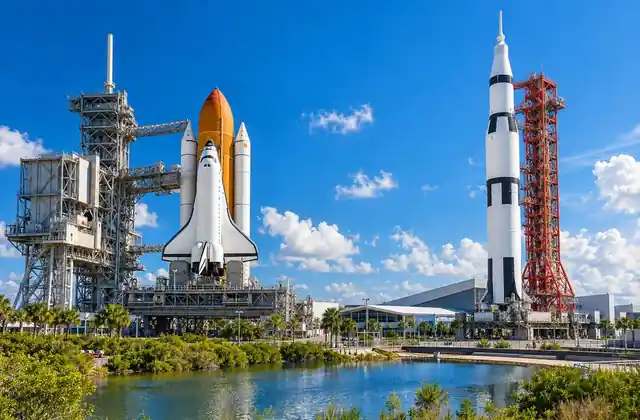
Even without a launch, the Kennedy Space Center Visitor Complex is a rewarding day. The Space Shuttle Atlantis exhibit, the Saturn V rocket displayed in its own hall and the bus tour toward the launch areas give real scale to the story of American spaceflight. Allow most of a day, and more for keen space enthusiasts.
For selected launches, the Visitor Complex sells special viewing packages, and the LC-39 Observation Gantry offers some of the closest legal public views of the pads. These sell out quickly for notable missions and are not offered for every launch, so watch for announcements and book promptly. Tickets and availability change; check before travel.
Pairing a launch with Cocoa Beach
The Space Coast is more than a launch site. Cocoa Beach, about an hour’s drive from Orlando, has a relaxed surf-town atmosphere, a long pier and wide Atlantic beaches. Merritt Island National Wildlife Refuge, which shares its land with the space center, is one of the finest birding areas in Florida in winter, and kayaking among the mangroves of the Banana River is a quiet counterpoint to a roaring rocket.
A gentle shape for the day: morning at the Visitor Complex, a seafood lunch near Port Canaveral, a late afternoon on the beach, and an evening launch over the water.
Tips for private groups and families
- Prefer evening and night launches. The flame lights up the sky and is visible from much farther away, sometimes even from Orlando.
- Bring a private vehicle. Traffic after a major launch can take hours to clear. A driver who knows the back roads, and who waits while you watch, makes the evening far more comfortable.
- Pack for waiting. Folding chairs, water, snacks, insect repellent and a light layer for breezy causeways.
- Listen for the booster. When a first stage returns to land, the sonic booms can be heard across the coast a few minutes after launch, which children find unforgettable.
- Have a plan B. If the launch slips, the day still works: the Visitor Complex, the beach or the wildlife refuge.
Let AHL plan your launch day
We track launch schedules, choose the viewing spot that suits your group, and arrange a private vehicle and guide so the day flows around the rocket rather than the traffic. Share your travel dates and we will design a flexible Space Coast plan with a free tailored quote.
FAQ
Can I see a rocket launch from Orlando?
Night launches are often visible from the Orlando area as a bright streak rising in the east, but for the sound and the full spectacle, watch from Titusville, Port Canaveral or Cocoa Beach, about an hour away.
How often are rocket launches scrubbed?
Delays are common and normal. Weather, wind, range conditions or technical checks can push a launch back by minutes or days, so allow two or three possible dates in your itinerary.
Is it free to watch a launch?
Several Titusville parks and roadside causeways are free. Some beaches and parks charge entry, and Kennedy Space Center Visitor Complex viewing requires admission. Fees change, so check before you go.
How early should we arrive?
For routine launches, an hour is usually enough. For crewed or high-profile missions, arrive two to three hours early, as parks and parking fill and roads close.
